
3D: Closing the Pop-Up Book
To be honest, when I began writing about the twenty-tens 3D trend I didn’t expect to write over 8000 words on the subject and I didn’t expect to spend a month doing it. Given the unpopularity of the trend (then and now), there are probably more reader-friendly ways I could have spent my time. If you’ve stuck with me through this, I applaud you.
There was just something in stereoscopic cinematography that drew me. 3D felt different at home than it did at the theater. I knew I especially loved Pina and Cave of Forgotten Dreams, but I didn’t know why. I certainly didn’t expect to write about the nature of beauty, desire, learning, and vocation. I didn’t expect to get closer to the heart of Wim Wenders and Werner Herzog’s distinct cinematic preoccupations. I definitely did not expect to spend so much time in Genesis, to work assiduously at tracing the overlap between the historical and archeological records and the biblical narrative.
Writing about 3D movies for more than a month has also given me the opportunity to talk via email and in person with a few of you about the trend.
The most common comment has been that 3D movies make some people feel nauseous. Yeah. The other twenty-tens cinematic trend that coincided with 3D was “shaky cam.” “Shaky Cam” can make you feel ill even in 2D. Combine that with stereoscopic imagery and they might as well hand out barf bags with 3D glasses at every screening. The best 3D movies keep the camera still and as much of the frame in focus as possible. Cinema is directed perspective. Pulling focus and quick camera moves are ways to achieve that. Our eyes cooperate with that directed perspective because it mimics how our eyes work – we whip-cut from object to object focusing on whatever we want and letting everything else blur. 3D makes our eyes think we should be able to focus on whatever we want. When we can’t it hurts.
I heard from a few of you about 3D movies you have enjoyed. All of those films are animated. There are a few things to note here. First, animation tends toward deep focus cinematography. (Pina does too.) Since everything in the image is in focus, your eyes can focus on what you want in the stereoscopic image. You can look at an animated image the same way you look at the real world.
Laika’s Stop Motion Films
Second, the twenty tens were also when Wil Vinton Studios rebranded as Laika and began earnest production on a slew of stop-motion animated films.
An aside: you really must watch the documentary Claydream. It’s available to watch for free on a host of platforms. Remember the California Raisins? The man behind them was Wil Vinton. They were his most popular creation by far, but he and his studio produced lots of things you would recognize throughout the 80s and 90s. Vinton coined the term “claymation,” and he had aspirations of becoming a Walt Disney-like personality before his story takes a surprising turn and his studio becomes Laika.
Laika’s films – Coraline, ParaNorman, The Boxtrolls, Kubo and the Two Strings – were particularly amenable to stereoscopic cinematography. Every part of the stop-motion process is drenched in forethought. The puppets are intricate and reward close inspection. The lighting is evocative. The focus is deep. The movement is smooth.
Coraline is an especially beloved 3D film and one of the only 3D blu rays that is expensive to obtain. I’ve been trying to find an affordable copy for a while, and, prompted by a conversation during this series with animator Aaron Holmes, I lucked into one! It lived up to its reputation. Henry Selick’s film already makes great use of lighting, color, and depth-of-field to immerse you in Coraline’s haunting story. The 3D adds to the effect. If you get a chance to see a Laika film in 3D, take it. I am going to continue my quest to pick up the other Laika 3D blu rays – as well as the post-conversion of Selick’s The Nightmare Before Christmas – for an affordable price.
Letting It Go
I also picked up a copy of Frozen in 3D during the past month. I knew Frozen was produced with the 3D experience of the film in mind from the beginning, but I had never seen the 3D version.
Now, I’ve seen Frozen more times that I can count. I “am” Anna for a few hours every day because my toddler daughter “is” Elsa all day every day and her favorite game is “Elsa/Anna” in which she uses her powers to freeze me, build ice castles, and tells me to “go away.” Unless I make her put on different clothes, she wears her Elsa costume dress from breakfast to bath time. When we watch Frozen, we typically only watch the first 35 minutes of the movie, until the end of “Let It Go,” after which all my daughter wants to do is sashay around singing and exercising her powers. Frozen is the water we drink. Frozen is the air we breathe. Frozen is life. I had lost sight of Frozen as a movie.
Watching Frozen in 3D enabled me to really see the film again. (I watched it at night by myself after the kids were asleep—they do not have the patience for wearing 3D glasses—and I made the mistake of telling my daughter I did that the next morning. She cried. She was angry at me. She is still angry at me about it. How dare I? Please don’t bring it up.) I’m not certain Frozen in 3D is a better movie than it is in 2D, but you can absolutely see that the film was meant to be seen that way. It’s full of fun staging that leans into the 3D effect. The first shot of the film is an ice saw blade shooting toward the camera. Olaf’s pointy carrot nose is a menace. Disney’s in-house 3D productions tend toward many, many layers of stereoscopic depth. Frozen’s fjords and mountain peaks look amazing.
And the 3D enhances subtle thematic and character moments too.
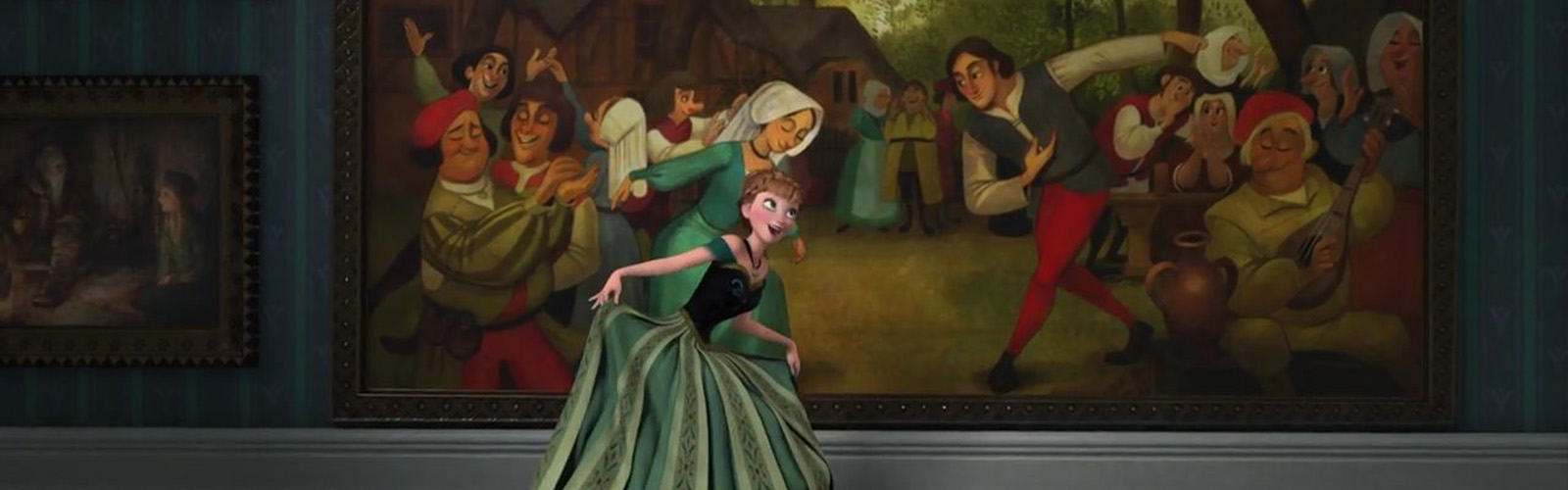
During “For the First Time in Forever,” as Anna dreams of falling in love at that night’s party, she leaps into frame with the Romantic paintings on the walls. The 3D highlights how her idea of love is flat.
Elsa’s ice is exceptionally beautiful. In 3D it’s easier to understand why she’d give up everything to exercise her powers fully. Light penetrates every icicle, every ice sheet, every snow drift. The wispy tendrils of her powers are little three-dimensional galaxies of snowflakes and color. Then when she snaps the world into frozen silence at the climax of the film, you are trapped in a snow globe. The ice crystals hang in the air so delicately, you feel like you can reach out and tap them each one by one. I’m happy I can watch this 3D version with my daughter one day when she’s old enough to stand the glasses. I think she will see the film anew as well.
Conclusion
In the end, 3D, like any other technique, can be used poorly or skillfully. It has rarely been done well. It was mostly a gimmick used to entice people off their couches and into theaters. Ironically, 3D movies are best viewed from your couch. Few filmmakers have had the time and money to figure out how to use 3D well but those who did have those resources figured out how to make a 3D movie more than simply a difficult-to-read cinematic pop-up book.
When it is used well, it can be a real credit to a film. It can make you aware of the layers of storytelling at work, as in Life of Pi and The Great Gatsby and Shrek. It can give you a glimpse of the immersion happening for the characters, allowing you experience something you cannot otherwise experience, as in Gravity and Avatar and Cave of Forgotten Dreams. It can augment a filmmaker’s strengths. It can reinforce or further facet the film’s thematic aims.
There is meaning in the way a movie tells its story. The same story told different ways has different meanings. Learning to notice the way any story is being told grants you a deeper and more exciting and more enriching experience of the story. 3D is another way to tell a movie story. It’s another way to see a movie. It’s another wrinkle that might get you to think about how this movie works, why it works, and what, if anything, it might be saying.