
Seeking Wisdom
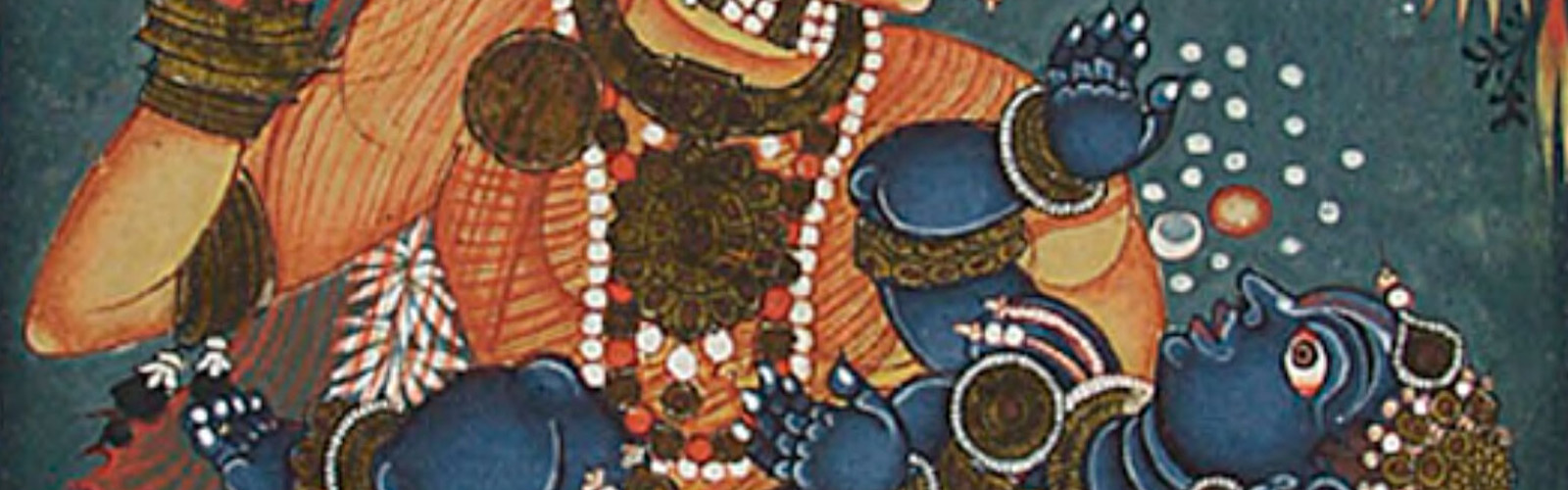
The image at top is an excerpt from “Infant Krishna shows Yashoda the Universe in His Mouth,” courtesy of the Harvard Art Museum.
This one is long. It deals with dental issues I have recently faced. Consider this a content warning if you deal, as I do, with great amounts of anxiety related to medical things and dental matters in particular.
I write because writing helps me create a cosmos out of the chaos of life. I share what I write because knowing it will be read helps me shape a more grace-filled cosmos, for myself and for my subjects, maybe for my readers. There’s a kind of community here between us. Communities need a cosmos. I think that’s why God created the universe. I hope what I write accomplishes something lesser but in the same tradition. As always, I hope you read what I write with the same hope.
I have all four of my wisdom teeth. Always have. That was the strangest things I learned during childbirth class – we are born with all of our teeth already in our heads. The baby teeth come out first and then we sing the song with the intentional lisp that heralds the arrival of the adult teeth AND THEN just when you think the trial of teeth growing has ended, wisdom teeth arrive like the stinger in a horror movie.
I have all four of my wisdom teeth, but if things had gone as planned yesterday I would have none of them now.
Wait.
Let’s back up. Not all the way to “thithtur thuthy thitting on a thithle” but almost there.
I have a long history of dental stress. My adult teeth came in like black sheep at a family reunion. I had teeth up too high. I had teeth antagonizing other teeth. I had one tooth whose brothers so effectually elbowed him away from the buffet he ended up under the table. At twelve years old I had oral surgery to fix all this with wires running around my mouth like someone was trying to keep Steve McQueen contained. It hurt. It sorta worked. There are still appliances in my mouth lest the fellas get out of line again.
And that same dentist drilled for cavities in my mouth like he was Daniel Plainview getting the best of God. My mouth is a patchwork of capped wells.
Throughout adulthood I’ve had a few more, let’s say disagreeable experiences with dentists across southern California. One got so angry at me for refusing x-rays – which I couldn’t afford and which the hygienist said I didn’t need – that I dared never visit her office again. Another billed me and my insurance company in such a way that I ended up paying many thousands more for a procedure than I should have paid. Oh yes, now that I pay for dental care myself, we’ve added financial anxiety to the list of neurosis I bring into dental appointments.
I’ve avoided going to the dentist for years. I also, I want to say, mind my dental hygiene like someone who would just about rather die than go to the dentist. I brush at least twice a day. I skip the toothpaste every once in a while. 4 out of 5 dentists agree that brushing with any brand of toothpaste helps protect your teeth against plaque and gingivitis, so I like to give that fifth dentist his due. I floss after every meal and every snack. I sometimes floss after every bite. I floss if someone near me eats something sticky. I floss on windy days if dust blows into my mouth. I do this brushing and flossing in private mostly. If someone (Krista) sees me brushing or flossing it tends to spark conversations about seeing a dentist.
My wife has had only positive experiences with dentists throughout her life. I’m not going to lie – this was a reason I married her in hopes that our children would get her teeth. So far, so good. My sweet, unspoilt, honest, well-meaning wife encourages me to go to the dentist for a regular cleaning and check-up (as one should). I do not go. She used to think I was being silly. In recent years she has come to understand the earnestness of my inhibition. She still thinks I should go. I think, why poke the bear?
I misspoke in the first sentence of this review. I do not have all my wisdom teeth. I have all my wisdom teeth except for a small piece of the one on the lower left side. That little piece broke off a couple of weeks ago while I was enjoying an onion ring. No pain then. No pain now. Just a little bit of missing tooth. “Sister Susie sitting on a thithle.”
So I decided I would finally have to go to the dentist again. I completed the too much effort required to find a dentist in my area that was covered by my insurance, taking new patients, is reviewed positively by patrons—the best horror stories no one is reading are the online reviews people leave for dentists—and willing to see me soon. I went to said dentist (without telling my wife I was going). He said I had one cavity—
This is a big win. I don’t want to gloss over this. I only had one cavity and it was where a wisdom tooth was pressing against a molar. The rest of my mouth was cavity-free. This is a significant accomplishment in my life, just rewards for fifteen years of dedicated, clandestine dental hygiene. Go, me.
He said I had one cavity, necessitating a crown, and that I should have that broken wisdom tooth removed and while I was out under anesthesia I should also have the other three removed too as they were likely to cause problems in the future.
I knew this was coming. Every dentist I’ve ever seen has told me this. It’s as common as barbers remarking how thick my hair is. (Redheads tend to have exceptionally thick hair, as well as a documented resistance to anesthesia, and a proclivity to getting skin cancer.)
When dentists recommend wisdom tooth extraction, I’ve always been able to say, “They are not causing me any trouble.” And the dentist can always say, “Yes, well, they could. You can wait until they cause you trouble to have them removed.” “Okay,” I say.
But this time I could not have that conversation. I had to jump straight to “Okay.”
So I made an appointment to have my wisdom teeth removed by an oral surgeon who was a real oral surgeon and not just someone pretending to be one who would use real anesthesia that would make me go to sleep during the procedure to remove my four wisdom teeth. I met that man yesterday morning, two days before Halloween, in a small office in a shopping center next to a Crumbl Cookies, a suspicious nail salon, and a BBQ joint with an obviously AI-generated sign.
I paid for the procedure before I went into the operating room because “You’ll be too loopy to do this afterwards,” the receptionist said. My wife and daughter waited in the room designated for such things snacking on cheese and crackers and not flossing neurotically between bites.
I already had heart monitors taped to my abdomen, a blood pressure cuff respirating on my arm, a pulse meter on my finger, and an oxygen tube running over my ears and into my nose by the time the oral surgeon entered the room.
“Good morning, Mr. Davidson. I’m [REDACTED] and I’ll be your oral surgeon today.” (As if I had one regularly from which he needed to distinguish himself.) “Let’s look at your x-rays. At your age I don’t recommend removing any wisdom teeth at all unless they are causing you problems. Are any of them causing you problems?”
“Well,” I said, “This one on my left side broke a couple of weeks ago. It doesn’t hurt but the dentist recommended we remove it and while we were doing that we should remove the others as well.”
“Are any of them causing you any problems?” he repeated as if I’d just spoken gibberish.
“Ummm… well, this one is broken and food gets stuck in these all the time because of how they came in and I tend to bite my cheek a lot when I eat and my tongue when I talk.”
“Hmm,” he said, “I don’t think removing your wisdom teeth is going fix that.”
I sat silently for a moment breathing deeply of the pure oxygen pumping into my nostrils.
“I’m confused,” I said, “I thought I was coming in today to have my wisdom teeth removed.”
“Yes, that’s what we’re discussing,” he said. “I see you have a cavity here.”
“They took care of that and crowned that tooth yesterday.”
“I wish they hadn’t done that.”
“What?”
“I’ll probably break that crown removing the nearby wisdom tooth,” he said.
“I asked about that,” I said, “and they said they needed to do it before the wisdom tooth was removed.”
“Hmm,” he said.
The oxygen hissed.
“You see,” he began, “when you’re young your bones are like rubber. You can remove teeth without doing much damage, but by the time you are–“ he looked at my chart “–42, your bones are all hard. The teeth have fused to the bone. When I remove the wisdom teeth I’ll likely break your jaw and make a hole from your mouth into your sinus cavity. You see this pencil-thick line here on the x-ray? That’s the nerve. I’ll likely sever it and you’ll lose sensation in your gums, lips, and tongue, probably for the rest of your life.”
“Likely?” I said.
“Yes. You are five times as likely to suffer permanent damage to your mouth, face, and sinuses when you have your wisdom teeth removed in middle age than if you do it when you’re young,” he said as if I had a time machine and could go back and do it when I was in grad school and I frequented the local food distribution service because I didn’t have enough money for food much less elective dental surgery.
“So, you don’t think I should have my wisdom teeth removed?”
“It’s extremely risky. I don’t do it unless I have to. So, knowing that, which teeth do you want to have removed?”
This oxygen hissed.
“Uhhh… what if we just removed the broken one and the one above it?”
“Okay. Yes, that one is broken. I can understand wanting it removed. The one above it has emerged fully. It’s no deeper in the bone than any of your other teeth, so I’m as likely to make a hole into your sinus cavity removing it as I would if I removed any of the others.”
Me, horrified honestly: “Okay.”
“Now,” he said, turning back to my chart, “I see you take [REDACTED] regularly. How regularly?”
“Yeah,” I said, “I take [REDACTED] from time to time to help modulate my depression. It’s sporadic, just ‘as needed’ to help me enjoy good times with my family.”
“Daily?”
“No. A couple of times a month, maybe once a day for a day or two if I’m really feeling down.”
“Okay,” he said, “You need to know that the anesthesia we use isn’t like what they use in hospitals. Even if it works, you won’t go to sleep. It’ll just make you drowsy and relaxed. It might not work at all. Sometimes when people are taking the medicine you are taking, the anesthesia doesn’t work at all or people get wild hallucinations and wake up and start tearing all this stuff off themselves in the middle of the procedure. Maybe you’ve seen this in the news. It’s all over the news.”
He said this to me.
(Later I looked this up and I couldn’t find anything anywhere that draws this connection between the medicine I occasionally take and any kind of anesthesia. I think the algorithm is feeding my oral surgeon fear.)
“So…” I said.
“So, what we’ve started to do is to give people like you a small dose of the anesthesia to see how you react. Then if you don’t have a negative reaction we give you more and then do the surgery.”
“Okay,” I said, terrified.
“Well, now that we’ve talked through all that, do you want me to remove your wisdom teeth on the right side of your mouth?” he asked.
“On the left side,” I clarified. “Oh, right,” he said. “Yes,” I said, denying every intuition in my being.
“Well, let’s see your arm. I’m going to insert the IV so we can try out the anesthesia.”
I extended my arm. He tied a thick, blue rubber band loosely around my lower bicep. “Pump your fist,” he said. I did. He started thumping the crease of my elbow. I looked away and focused on curling and uncurling my toes. Close friends and family will know that the tiny prick of the IV needle is, believe it or not, the most terrible part of all of this for me. Over the past decade of getting regular physicals I have worked up a baseline of courage that enables me to get stuck without nurses worrying I am going to faint. Bloodwork withdrawals happen quickly. The nurses are good at it. And those needle pricks aren’t preceded by conversations like the one I just related to you.
He couldn’t find a vein but he didn’t let that stop him. He inserted the needle in my arm three times before he said, “I think I got one!” and then he took the needle out again for some reason and said, “Oh, no. I think I lost it.” The way he said, “Oh, no” reminded me of Phoebe Buffay.
He stuck a piece of gauze over the holes he made in my inner arm and started looking at my hand and wrist. He felt around my wrist in places no person has ever considered putting an IV in me before. Then he asked to see my other arm. He wrapped the rubber band around it loosely and began thumping. I breathed.
“Well, I don’t think I’m going to be able to get a vein. I had one but now I think it’s collapsed. If you want to do this with anesthesia you’re going to need to find a hospital or an oral surgery clinic where they have people who are good at this.”
If this isn’t a place where they regularly do oral surgery, where they have people who are “good” at inserting an IV, what the heck is this place? I thought through the lightheadedness I was fighting.
And then he said, not joking at all, “If you want, we could just do this the old fashioned way, with topical anesthesia.” Both of the dental assistants in the room laughed incredulously when he said that.
“Nah, I’m done,” I said. “Yeah,” one of the assistants said and immediately began taking the monitors and cuffs and oxygen tubes off of me. The last thing I heard the man who I thought was an oral surgeon say as I all but ran out of the room was, “Make sure he gets a refund.”
So I still have all my wisdom teeth and I figure I probably always will. There is sardonic humor in the way I related that interaction but I wrote out what was said and how it was said as accurately as I could. I think I was pretty alert. I was breathing pure oxygen throughout the ordeal.
A day removed and now that my anger has subsided, I really think he really, really, really didn’t want to remove any of my wisdom teeth and was really, really, really, really bad at communicating it. I’m not excusing his manner. I’m just trying to make sense of it. I was in a position of great vulnerability. He was the expert whom I was trusting to make good decisions for my benefit, and he put those decisions off on me. Most generously reckoned, he was making sure I understood the risks associated with a surgery he viewed as elective, and then when none of those warnings dissuaded me from the operation—since I viewed it as necessary—we were both spared any regrettable ramifications by his inability to administer the anesthesia. Viewing it like that enables me to release my anger.
I am not an angry person. In moments, frustration flares up into anger, but I pretty quickly let it go. Shame is the emotion that simmers always in my soul. Being so angry throughout the day yesterday was distressing for me. Anger kept coming in waves. Krista, who had taken the day off work to be my ride from the surgery and to care for me throughout the day, kept discovering me frozen, standing, staring into the distance as I weathered another wave of anger permeating my entire body.
And every wave was accompanied by loud thoughts of all the things I had done and had not done which had led to and contributed to that situation. Should I have had the wisdom teeth removed when I was young? Does treating my depression mean I cannot receive anesthesia? Did I misunderstand my dentist? Was I wrong to seek the extraction? Like I said, shame is my base state. My feelings of shame make me feel like an “other,” and the upside to that is that I am extraordinarily aware of the “othering” of others and eager to include others and so alleviate that wrong when I encounter it in life. The intensity of my anger was something new.
As shame is my go-to emotion, anger is my wife’s. She was a great help to me in those moments. She helped me accept that the oral surgeon had not communicated with me properly, that his malfeasance wasn’t my fault. She helped me see that the intensity of my anger was because I had experienced injustice. Krista’s familiarity with anger makes her exceptionally aware of injustice and eager to correct it. Her clarity often gives me strength. It certainly did yesterday.
Will I ever have my wisdom teeth removed? I don’t know. Probably not. I guess I’ll talk to a dentist again and see if there is anything else that can or should be done for my broken tooth. Maybe I’m just at that age where doctors stop prescribing remedies for illness and start betting that I’ll die before the problem becomes too severe. I know I’ll never see that oral surgeon again.
Today I’m grateful I don’t have a broken jaw, a hole in my sinus cavity, or permanent nerve damage that makes me incapable of experiencing a kiss. “Dodged a bullet” is the phrase people have used when I’ve told them about this ordeal, and I always think I’d rather not be in a situation where I’m being shot at.
I don’t have a good resolution for this. Like I said at the beginning, I write to understand. As the teacher wrote in Ecclesiastes, you can seek wisdom and understanding all your life, which I’ve always understood to mean you can keep seeking them and uncover them more and more but never finish. You will never get to the bottom of everything. Sometimes things just continue on.
Sometimes, things just end.